
What Are Exosomes? And Why Are We Putting Them on Your Face?
If you’ve spent any time wandering around the skincare internet lately, you’ve probably seen the word EXOSOMES.
Exosome serums. Exosome facials. Exosome treatments. Exosome this. Exosome that.
And, as happens so often in skincare, something genuinely interesting gets introduced and suddenly everyone starts talking about it like it was delivered from the heavens specifically to make us look 27 again.
So let’s talk about what exosomes actually are because the real science is considerably more interesting than the hype.
First Things First: What Is an Exosome?
Your cells are constantly communicating with one another.
They don’t have tiny phones, unfortunately.
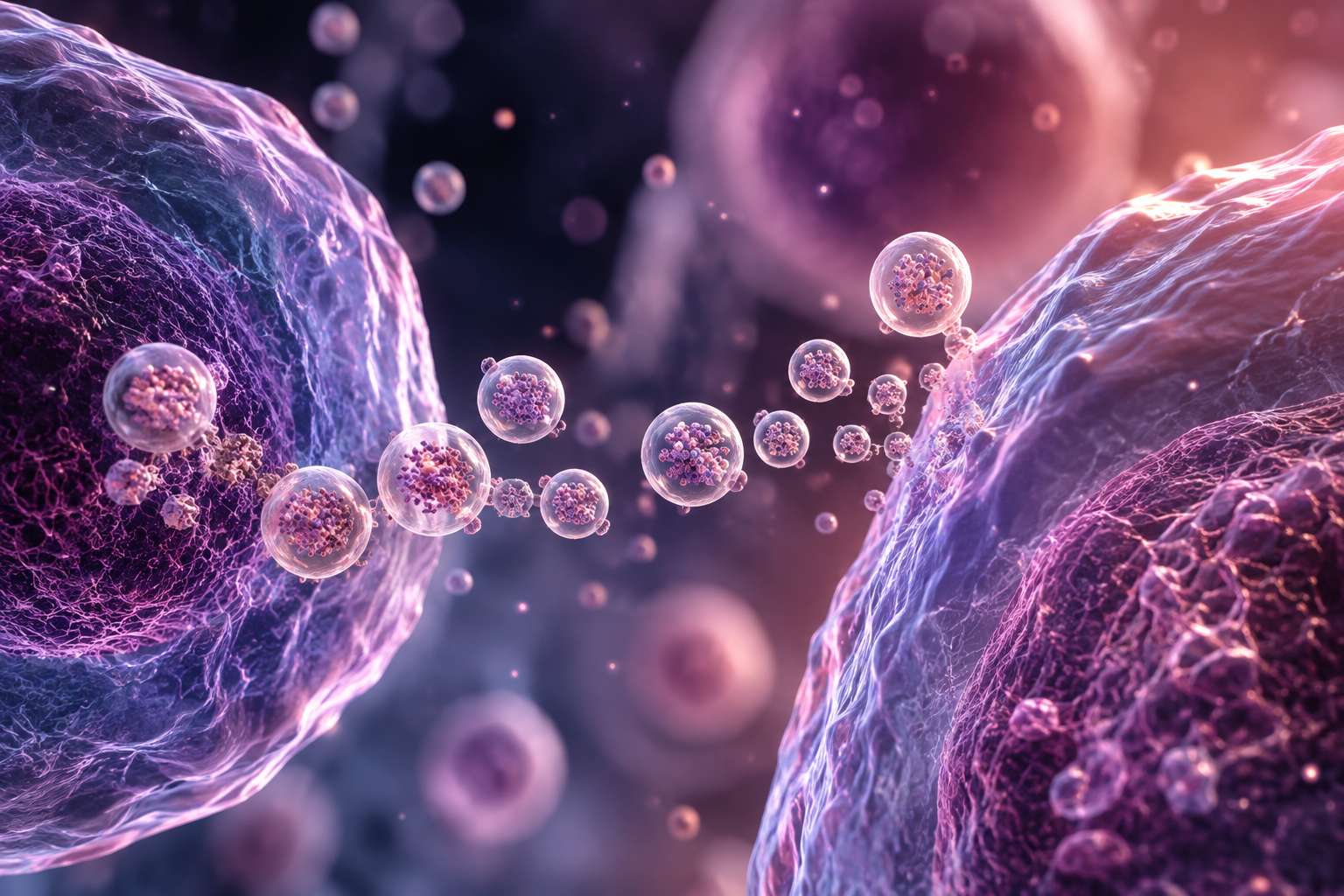
Instead, one of the ways cells communicate is by releasing microscopic packages called extracellular vesicles. Exosomes are a type of these tiny vesicles.
Think of them as little biological envelopes carrying information from one cell to another.
Inside can be things like proteins, lipids and different types of RNA. When another cell receives that package, its contents can influence how that cell behaves.
In other words:
Exosomes aren't cells. They're messengers.
And that distinction is important.
Why Is Everyone Suddenly Talking About Them in Skincare?
Because cellular communication plays a major role in what skin does every day including responding to injury, regulating inflammation and remodeling tissue.
Researchers have therefore become very interested in whether exosome-based preparations could be used to influence some of those processes.
And the early research is pretty fascinating.
Studies involving exosome-based treatments have reported improvements in things like:
skin hydration
elasticity
the appearance of fine lines and wrinkles
pigmentation
overall skin quality
Researchers are also investigating their relationship to collagen production, inflammation and wound healing.
That's why you're suddenly hearing so much about exosomes in regenerative and aesthetic skincare.
But here's where we need to put on our Dermaspace skepticism hat.
Are Exosomes a Miracle?
No.
Because nothing in skincare is.
There is legitimate and growing scientific interest in exosomes, but we're still relatively early in understanding how best to use them for skin rejuvenation.
Human studies are encouraging, but they're still limited compared with ingredients we've been studying for decades. Exosome products can also differ enormously depending on their source, how they're manufactured, what's actually in the finished product and how they're delivered to the skin.
So when someone tells you that exosomes are going to “reverse aging,” “regenerate your skin” or otherwise turn you into a newborn baby, you have our permission to raise an eyebrow. (Unless you have Botox, then you can just think about raising an eyebrow)!
What interests us isn't magic.
It's cellular signaling.
Think of Your Skin Like a Construction Site
Here's an easier way to understand it.
Imagine your skin is constantly running a construction project.
You've got workers repairing things, removing damaged material, building structural support, responding to problems and trying to keep the whole operation running smoothly.
Exosomes are a little like messages being passed between the people on that construction site.
They aren't the bricks.
They aren't the workers.
And they don't rebuild the building by themselves.
They're carrying instructions.
That communication is what makes them so interesting.
So Why Put Them on the Skin?
This is where things get especially interesting from a professional skincare perspective.
Skin is very good at being a barrier. That's literally one of its primary jobs.
Which means putting an interesting ingredient on top of the skin doesn't automatically mean it's going exactly where we want it to go.
That's why researchers and skincare professionals are increasingly interested not only in what we're putting on the skin, but how we're delivering it.
Some of the emerging human research on exosome-based skincare has looked at topical application alongside procedures such as microneedling and other technologies designed to enhance treatment or delivery.
And that leads us to something we've been thinking about quite a bit lately at Dermaspace:
An ingredient is only one part of a treatment.
What you're delivering, how you're delivering it, and what you're asking the skin to do with it can be equally important.
And exosomes are only one piece of that puzzle.
The Dermaspace Bottom Line
Exosomes aren't stem cells.
They aren't filler.
They aren't Botox.
And they aren't magical youth particles.
They're microscopic messengers involved in communication between cells, and researchers are investigating how that signaling can be harnessed in areas including skin rejuvenation and repair.
The science is exciting.
The marketing is occasionally ridiculous. Hello TikTok I’m talking to you!
And somewhere between those two things is where we like to live.
So yes — we've been playing with exosomes.
But here's the interesting part:
We're not particularly interested in what exosomes can do alone.
We're interested in what happens when you combine different approaches to skin rejuvenation and give each one a different job.
We’ve already been using Exosomes by Osmosis Holistic Beauty during microneedling to drive deeper rejuvenation and boost the soothing, plumping effects of our HA-based serums... and now we've been working on something a little special.
Exosomes by Osmosis is Part One.
Next week, we're going to talk about Osmosis Vitamin A Facial Infusion: Dermal Rejuvenating System, and why it's very different from simply putting traditional retinol on your face.
Then we'll introduce you to something called liposomal delivery.
Three technologies.
Three different jobs.
And eventually, we're going to put them together in a powerhouse facial treatment.
Stay tuned.