
Liposomes in Skincare: Tiny Delivery Systems with a Big Purpose

When it comes to professional skincare, choosing the right ingredients is only part of the equation. Those ingredients also need an effective way to reach the skin.
That is where liposomes come in.
Liposomes are microscopic delivery systems designed to carry beneficial ingredients and help distribute them more effectively within the skin. They may be tiny, but the science behind them has made liposomes an important part of advanced skincare formulations—and the third technology in our educational infusion series.
What Are Liposomes?
Liposomes are extremely small, sphere-shaped vesicles made from phospholipids—the same type of fatty molecules found in the membranes surrounding our skin cells.
Each liposome has a protective outer layer surrounding a small inner compartment. This structure allows it to encapsulate and transport selected high-performance ingredients.
Think of a liposome as a microscopic delivery capsule. It helps protect what is inside while supporting a more efficient and controlled release of those ingredients to the skin.
Because phospholipids are compatible with the skin’s natural lipid structure, liposomes can interact effectively with the skin’s surface and help improve ingredient delivery.
Why Ingredient Delivery Matters
The outermost layer of the skin, known as the stratum corneum, is designed to act as a barrier. Its job is to keep unwanted substances out while helping prevent excessive water loss.
That barrier is essential—but it also means that simply applying an ingredient does not guarantee that it will be absorbed or delivered effectively.
Liposomes help address this challenge by surrounding selected ingredients with a phospholipid structure. This can help protect delicate ingredients, improve stability, support more even distribution and enhance their delivery to the skin.
In other words, liposomes are not necessarily the active ingredient. They are the delivery system helping other ingredients reach the skin more effectively.
How Are Liposomal Serums Applied?
Liposomal serums do not require aggressive treatments or traditional microneedling.
Depending on the formulation and the treatment being performed, they can be gently massaged into the skin or applied using a specialized nano tip. Nano infusion helps distribute the serum across the skin’s surface without needles or the controlled injury associated with microneedling.
Because liposomes are already designed to assist with ingredient delivery, the goal is to work with that technology—not force it into the skin through an unnecessarily aggressive procedure.
The formulation, application method and condition of the skin all help determine how a liposomal product should be used.
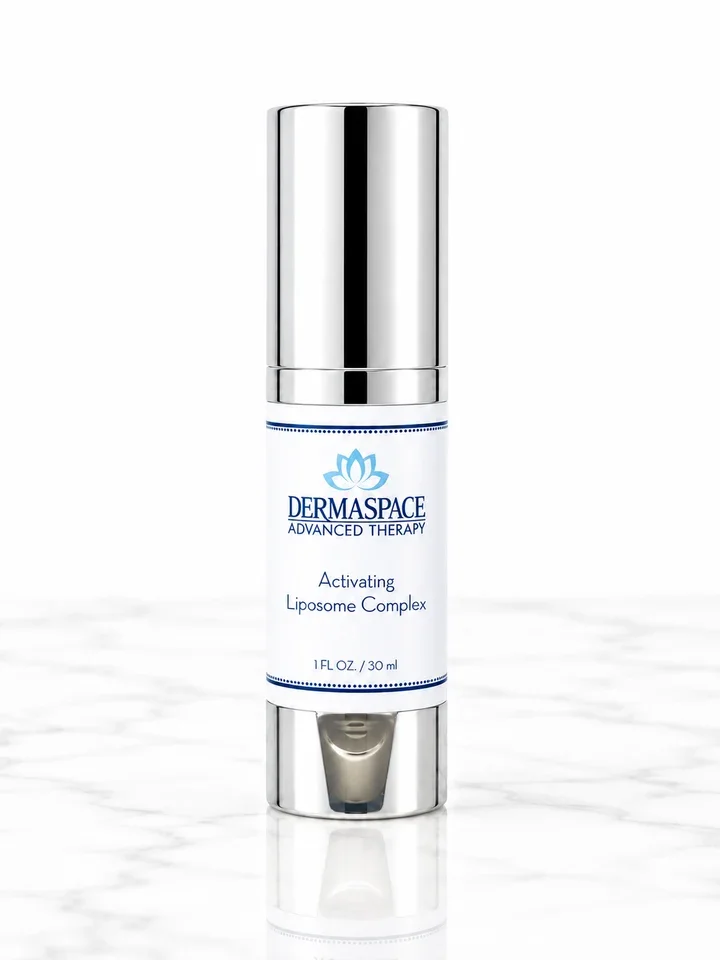
Liposomal Technology at DERMASPACE
Liposomal technology is not entirely new to DERMASPACE. It is already part of our own DERMASPACE Advanced Therapy Activating Liposome Complex.
This lightweight, water-based treatment combines phospholipids with yeast-derived 1,3/1,6 Beta Glucan, multiple forms of hyaluronic acid, Tremella, Trehalose, Ergothioneine and Saccharomyces Lysate.
Together, these ingredients help:
Rapidly boost hydration
Calm the appearance of sensitive or environmentally stressed skin
Support the skin following stress or professional treatments
Soften the appearance of surface lines and crepiness
Improve the appearance of visible imperfections and uneven color
The Activating Liposome Complex is an excellent example of how a thoughtfully developed delivery system can help support the performance of beneficial skincare ingredients.
It can be used at home as part of a daily skincare routine and may also be incorporated into professional DERMASPACE treatments when appropriate.
Who Can Benefit from Liposomal Skincare?
Liposomal skincare can be especially beneficial for skin that appears:
Dry or dehydrated
Dull or lackluster
Rough or uneven in texture
Sensitive or environmentally stressed
Depleted and in need of nourishment
Ready for a smoother, healthier-looking glow
However, not every liposomal formula is identical. Its benefits depend on the ingredients being carried, the quality of the formulation and how it is applied.
“Liposomal” describes the delivery technology—not the complete purpose of the product.
Are Liposomes the Same as Exosomes?
No. Although the names sound similar, liposomes and exosomes are not the same thing.
Liposomes are phospholipid vesicles created primarily to encapsulate and deliver selected ingredients.
Exosomes are naturally occurring extracellular vesicles involved in cellular communication. In professional skincare, exosomes-based formulas are used to support the appearance of skin renewal and recovery.
Both involve microscopic vesicles, but they come from different sources and perform very different functions.
Liposomes vs. Traditional Serums
A traditional serum places its ingredients directly onto the skin. Its effectiveness depends on the formulation, ingredient size, stability, condition of the skin barrier and application method.
A liposomal serum packages selected ingredients within phospholipid vesicles. This can help protect the ingredients and support how they are distributed and delivered to the skin.
That does not mean every liposomal serum automatically performs better than every traditional serum. The quality and purpose of the complete formulation still matter.
Liposomes are the vehicle. What that vehicle is carrying is equally important.
The Third Piece of the Puzzle
First, we explored Exosomes and their role in supporting the appearance of skin renewal.
Next, we introduced Facial Infusion with a specialized nano tip, which helps deliver Vitamin A and other targeted ingredients while improving the appearance of tone and texture.
Now we have explored Liposomes—microscopic phospholipid delivery systems that help carry selected ingredients to the skin.
Three different technologies. Three distinct purposes.
Next week, we will introduce a very special new facial that brings all three technologies together in one advanced treatment.
The final reveal is almost here.